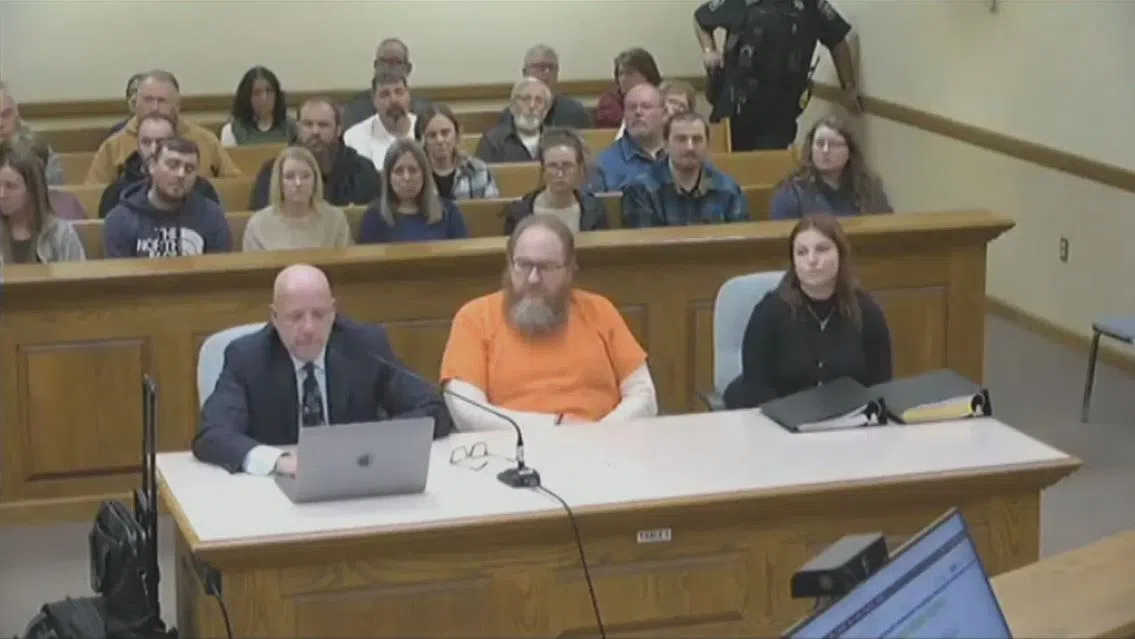
Tony Haase, center, appears in court March 20, 2024, for the 1992 murders of Tanna Togstad and Timothy Mumbrue. (Image courtesy Waupaca County courts/Zoom)
WAUPACA (WTAQ-WLUK) – Tony Haase wants an appeals court to hear an appeal of a decision allowing DNA evidence before his next trial month for the 1992 murders of Tanna Togstad and Timothy Mumbrue.
Haase faces two counts of first-degree murder for the March 21, 1992 deaths at a farmhouse in Royalton. Haase was charged in 2022 after confessing to the murders. Haase’s father was killed in a snowmobile crash in 1977, with Togstad’s father one of the drivers involved.
The trial, which was scheduled for up to six weeks, is scheduled to start July 14.
Earlier this year, Waupaca County Judge Raymond Huber ruled that DNA evidence collected from Haase from a pen used during a traffic stop could be used by prosecutors at trial.
In what’s known as interlocutory appeal, attorney John Birdsall asked the appeals court Monday for permission to appeal the ruling before trial, rather than wait until the case is concluded.
Such appeals are not automatically granted. The appeals court has the discretion to hear the argument now, or wait until after a verdict has been reached. If the petition is granted, that process would take months, and would postpone the trial indefinitely.
In his motion, Birdsall argues the DNA collection through a “ruse traffic stop” circumvented Haase’s Fourth Amendment rights.
“The trial court was wrong on every legal holding and this Court must intervene to clearly draw the line that police powers may not be used to unlawfully collect DNA samples and that any subsequent collection and analysis of DNA or other evidence must not be prompted by the earlier illegal collection,” Birdsall wrote. “A reversal of the trial court’s denial of Mr. Haase’s motion will terminate this litigation and protect him from the substantial and irreparable harm of having to defend himself at trial against the evidence collected as a result of the illegal ruse stop and seizure during the July 6, 2022 traffic stop.”
The case echoes a Marinette County double murder case, where Raymand Vannieuwenhoven was convicted in 2021 for the 1976 murders of David Schuldes and Ellen Mathys. In that case, the courts ruled that the phony police survey used to gather Vannieuwenhoven’s DNA was an appropriate tactic.
Birdsall contends the circumstances of the two differ, however.
Vannieuwenhoven “is critically distinguished from the instant facts because licking an envelope and returning it to the police was “voluntary” but handling a clipboard, citation and pen upon a command from an officer is not. In Vannieuwenhoven the police were invited into his home and Mr. Vannieuwenhoven was offered a choice at each stage of his interaction with law enforcement. “[L]aw enforcement’s trickery” caused Mr. Vannieuwenhoven to consensually give an envelope that he had sealed with his saliva directly to law enforcement who he had invited into his home. The officer did not demand that Mr. Vannieuwenhoven hand him the envelope and Mr. Vannieuwenhoven was not coerced or under duress when he gave the envelope to law enforcement,” Birdsall wrote.
Birdsall also argues a motion by the state challenging Haase’s qualification for public defender puts a cloud over the case that may not resolved in time for trial.
The state has not responded to the petition.
Although the murders happened in 1992, Haase wasn’t charged until August 2022.
Police identified Haase as a suspect, and a DNA sample was taken from him during a traffic stop. Test results showed him to be a “major male contributor” to the fluids recovered from Togstad’s body, the complaint states.
Haase initially denied any involvement, but during questioning, he eventually admitted to the murders.
Eventually, Haase disclosed to investigators that his father had been killed in a snowmobile accident when he was 5 or 8 years old. Investigators had discovered Haase’s father died on Dec. 31, 1977, when Haase was 7 years old.
Haase continued and described that his father was operating a snowmobile in a group of three that was racing. The second snowmobile hit his father’s, and his father was killed. The third snowmobile then ran over the driver of the second. He described it as a horrible accident. One of those drivers was Togstad’s father.
Haase explained that on the evening of March 20, 1992, he became very drunk as he went from one bar to another by himself. For some reason, he started to think about the accident that killed his father. Those thoughts led to him going to the home of Tanna Togstad.
Haase could not articulate why he went there but insisted it was not to hurt anyone. He described himself as being in a drunken stupor that night. Haase describes getting into a “scuffle” with Mumbrue. He could not remember if he had brought a knife or if the knife was at the house. During the “scuffle,” he and Mumbrue were wrestling while standing up, and he moved his arm in a stabbing motion toward Mumbrue’s chest. He described Mumbrue falling to the floor near the foot of the bed.
Haase remembered Togstad yelling, “What the f—,” and that is when he punched her in the face. It is believed he would have knocked her out at this time. At some point, Togstad started to stir, and that is when he stabbed her in the chest.
When asked why he didn’t tell investigators right away, Haase replied, “I didn’t want it to sound like I had it planned.” Haase told investigators he did not know why he did it. At this point, Haase told investigators when he saw the news report he thought, “Holy f—, what did I do?” the complaint states.
When they were killed, Togstad was 23 and Mumbrue was 35. Togstad died of one stab wound to the chest, while Mumbrue was stabbed multiple times, according to the autopsy report cited in the criminal complaint.




Comments